

Insights
The Future of Data Contracting in Specialty Insurance

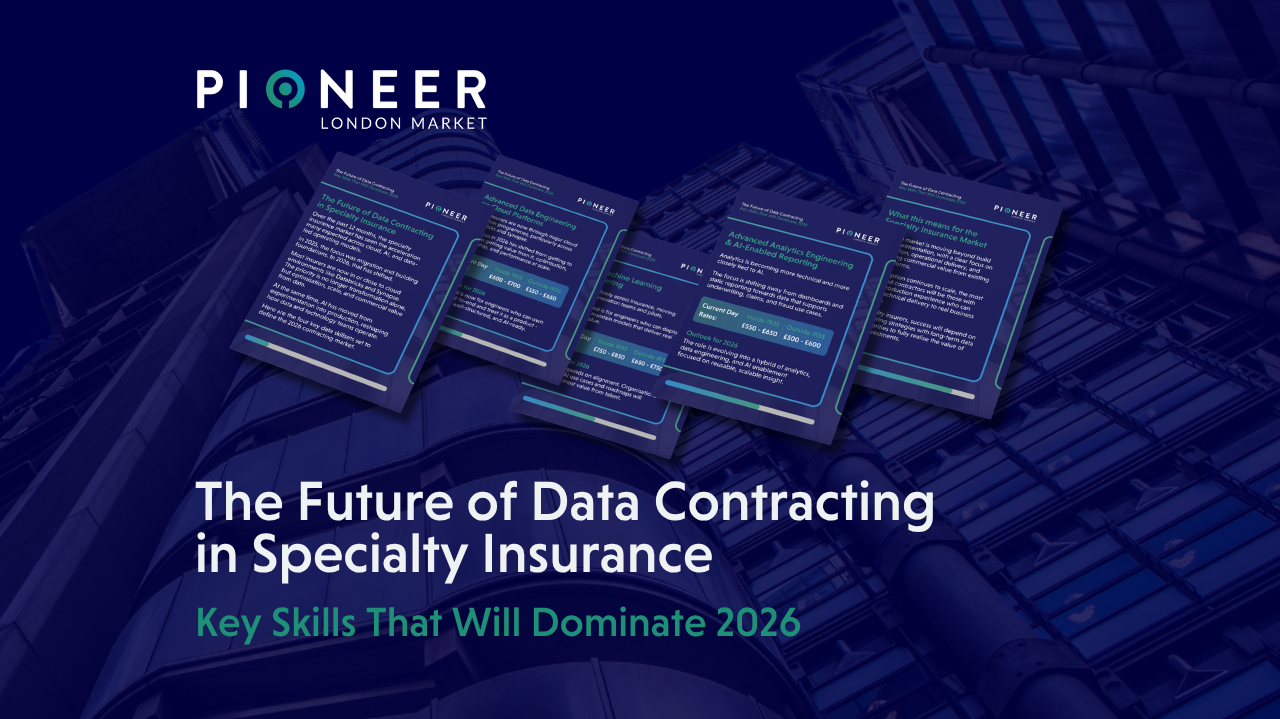
The Future of Data Contracting in Specialty Insurance: Key Skills That Will Dominate 2026
What are the most in-demand data contracting skills in UK specialty insurance right now? Following on from our 2025 outlook, the past 12 months have delivered exactly the level of acceleration many in the market anticipated, particularly across cloud adoption, AI capability, and the continued evolution of data-led operating models within insurance.
In 2025, much of the focus centred on large-scale cloud migrations, platform builds, and establishing foundational data capabilities. Fast forward to 2026, and the conversation has shifted. Most major insurers have now completed, or are well advanced in, their migration journeys, particularly onto platforms such as Databricks and Synapse. As a result, demand is no longer centred on transformation delivery alone, but on what comes next: optimisation, scalability, and commercial value extraction from data.
At the same time, AI has moved decisively from experimentation into production, reshaping not just data teams, but the broader technology landscape within specialty insurance. Against that backdrop, here are the four key data skillsets set to define the insurance contracting market in 2026.
1. Advanced Data Engineering on Cloud Platforms
What does a data engineer earn in insurance contracting in 2026?
In 2025, demand was heavily weighted towards engineers supporting migration programmes. By 2026, that demand has matured, with insurers now prioritising engineers who bring deep, hands-on experience building and optimising within cloud-native environments (e.g. Databricks, Synapse), rather than simply implementing them. It's no longer about getting to the cloud; it's about maximising the value of what's already been built.
From a market perspective, contract rates have stabilised, accompanied by a growing permanent market for this resource. However, high-quality engineers with proven delivery experience in production environments remain in strong demand.
Inside IR35
Outside IR35
Treating data as a managed product is set to become a defining theme for 2026, with organisations increasingly expecting engineers to own datasets end-to-end, rather than simply building pipelines to move data between platforms.
Outlook for 2026: Organisations will increasingly expect engineers to ensure datasets are reliable, well-documented, and fit for consumption by both humans and AI systems. The engineers who thrive will be those who think beyond the pipeline and take genuine ownership of data quality and usability.
2. AI & Machine Learning Engineering (From Experimentation to Production)
How is demand for AI engineers changing in the UK insurance sector?
The evolution here has been significant and fast. In 2025, AI was still, in many cases, sitting in innovation teams or proof-of-concept phases. In 2026, AI is becoming operational and commercially driven. There is now a clear shift towards AI engineers who can deploy, scale, and maintain models in production environments and understand the real-world business application.
Importantly, demand is no longer isolated to dedicated AI roles. We're seeing data engineers, architects, and even analysts expected to have some level of AI integration exposure, with a broad push toward AI-enabled data systems.
Inside IR35
Outside IR35
The most successful insurers will be those that align AI hiring with clear commercial objectives and well-defined adoption strategies, not those that hire reactively.
Outlook for 2026: Growth in this space will continue at pace, with a growing emphasis on strategy alignment. Organisations that clearly define their AI roadmap and use-case priorities will be best placed to fully realise the value of AI talent.
3. Advanced Analytics Engineering & AI-Enabled Reporting
What skills do analytics contractors need in insurance in 2026?
Analytics roles in insurance are becoming more technical and more closely connected to AI, moving beyond simply building dashboards and reports. In addition to tools like SQL and Power BI, there is now growing demand for professionals who can help prepare and shape data for use in areas such as claims analysis, fraud detection, and underwriting decisions.
AI is also starting to play a bigger role, helping teams generate insights and support more advanced forms of analysis. Reporting is still important, particularly for regulatory and operational needs, but the focus is shifting away from static reports towards more automated, reusable data that different teams can access and use themselves.
Inside IR35
Outside IR35
Outlook for 2026: Analytics roles will continue to evolve into a blend of reporting, data preparation, and AI support, with increasing demand for professionals who can bridge the gap between business needs and more advanced, AI-driven ways of working across insurance.
4. Data Governance, Quality & AI-Aware Frameworks
Why is data governance becoming critical in AI-driven insurance organisations?
Data governance is not a high-growth standalone hiring area in the same way as AI or data engineering, but it is becoming increasingly critical as insurance organisations mature their data and AI capabilities. Demand is growing for clear data ownership, lineage, and control frameworks, with governance increasingly embedded into data engineering pipelines and AI delivery.
Rather than existing as a separate function, data governance is becoming part of how modern data platforms and AI systems are designed and operated. However, many organisations are still maturing their approach rather than operating fully established governance models.
Head of Data Governance / Lead — Inside IR35
Head of Data Governance / Lead — Outside IR35
The key shift in 2026 will be towards embedding governance into everyday data and AI development processes, ensuring data is trusted, traceable, and suitable for both operational and automated decision-making.
Outlook for 2026: Data governance will continue to increase in importance, driven by AI adoption and tightening regulatory expectations.
Summary: What the 2026 Insurance Data Contracting Market Looks Like
The 2026 insurance data contracting market is shifting from building and experimentation towards optimisation, operationalisation, and delivering clear commercial value. The most in-demand contractors will be those with proven production experience who can bridge technical delivery with business outcomes in an increasingly AI-driven environment.
For insurers, success will depend on aligning hiring strategies with long-term data and AI goals, to fully realise the value of existing platforms and investments.
Looking for your next data contract in insurance, or searching for specialist talent? Pioneer Search works exclusively within the insurance data and technology market. We understand the skills, the rates, and the hiring landscape better than anyone.
Get in touch with our team to discuss your requirements.